44 nutrition labels health canada
Food labels - Canada.ca Nutrition Labelling Online Course Services and information Food labelling changes About the improvements to the nutrition facts table and list of ingredients. Technical documents Documents for industry that outline rules for specific labelling requirements. Understanding food labels Nutritional Information - Food Labels Canada The Nutrition Facts Table provides information on the serving size, calories and 13 core nutrients, such as fat, sodium and sugar. It also provides % Daily Value, which helps you determine if the food product contains a little or a lot of a certain nutrient. In general, 5% or less is considered a little and 15% or more is considered a lot.
Nutrition labelling - Canadian Food Inspection Agency Reference information. Presentation of the nutrition facts table. Graphical and technical requirements. Specific foods. Food intended solely for infants 6 months of age or older but less than 1 year of age. Foods for use in manufacturing other foods. Foods for use in commercial or industrial enterprise or institution.

Nutrition labels health canada
Use food labels - Canada's Food Guide Nutrition facts table: provides information on serving size, calories, certain nutrients and % daily values (% DV). The % DV can be used as a guide to show you if the serving of stated size has a little or a lot of a nutrient. 5% DV or less is a little 15% DV or more is a lot PDF CANADA'S NEW FOOD LABELLING REGULATIONS - ESHA Research Nutrition Facts Serving Size 1/2 cup (80 g) Servings Per Container about 8 Amount % Daily Value Calories70 Fat1.5 g2% Saturated 0.3 g + Trans 0.3 g 3% Cholesterol0 mg Sodium250 mg10% Carbohydrate11 g4% Fibre 3 g12% Sugars 3 g Protein4 g Vitamin A 20 % Vitamin C 15 % Calcium 2 % Iron 8 % Nutrition Facts Nutrition labels: Finding out about the food you eat All information on the nutrition label is based on a specific amount of food called the serving size. When you compare products, ensure that the serving sizes are the same. When comparing foods, use percent daily values (% DV) to find out if a food has a little or a lot of a nutrient. Choose foods with lower amounts of total fat, saturated fat ...
Nutrition labels health canada. How to Read Nutrition Labels Like a Pro - MSN Located directly under the "Nutrition Facts" title at the top of the list, it displays the amount of fat, calories and nutrients you're consuming. Compare the specific amount of food displayed on... Nutrition facts tables - Canada.ca There are 13 core nutrients that must be listed in a nutrition facts table. However, here is a list of some of the nutrients that are optional to include: folate magnesium niacin phosphorous potassium riboflavin selenium thiamine vitamin B12 vitamin B6 vitamin D vitamin E zinc Foods that do not have a nutrition facts table Learn How the Nutrition Facts Label Can Help You Improve Your Health The Nutrition Facts label on packaged foods is based on updated science and dietary recommendations for Americans. Using the label can help you choose foods for a healthy diet. The label is required on all packaged foods made in the United States and imported from other countries. The US Food and Drug Administration (FDA) issued regulations in ... Understanding Food Labels in Canada It must include the serving size, calories, % Daily Value and 13 core nutrients (fat, saturated fat, trans fat, cholesterol, sodium, carbohydrate, fibre, sugars, protein, vitamin A, vitamin C, calcium and iron). The format is consistent across all food products to allow for easy comparison between different items.
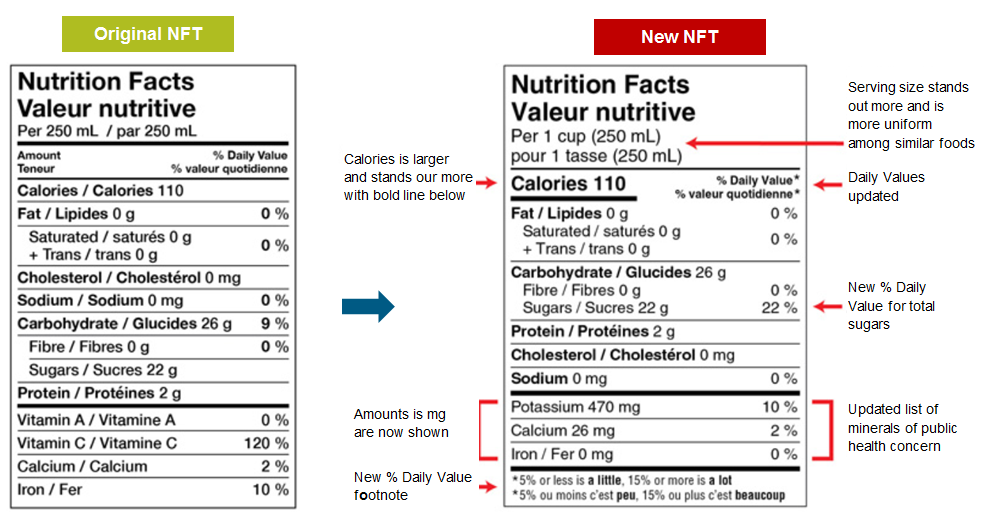
Food Labels | HealthLink BC Labels include the nutrition facts table and ingredient list. Some products might also have nutrient content or health claims. The nutrition facts table lists the amounts of nutrients that you want more of, like fibre and calcium, as well as the amounts of nutrients that you want less of, like saturated fat and sodium. 9 changes to nutrition labels Health Canada wants you to see 7. A percent daily value will be added for sugar, based on a 100 g limit. 8. A percent daily value will be added for potassium. Most Canadians are not getting enough of this nutrient, says Health Canada. 9. Vitamin A and vitamin C will be dropped from the label because most Canadians get enough of these nutrients in their diets, says Health Canada. Nutrition Labelling - Canada.ca Nutrition labelling is information found on the labels of prepackaged foods. The legislated information includes: The Nutrition Facts table The ingredient list Some optional nutrition claims These give you information about the nutritional value of a food. You can use this information to make healthier food choices and achieve overall good health. PDF Label Reading the Healthy Way - Alberta Health Services Nutrition Facts Per 1 cup (30 g) Calories 180 % Daily Value* Fat 2 g 3 % Saturated 0.4 g + Trans 0 g 2 % Carbohydrate 35 g Fibre 4 g 15 % Sugars 7 g 7 % Protein 5 g Cholesterol 0 mg Sodium 120 mg 5 % Potassium 450 mg 10 % Calcium 30 mg 2 % Iron 8 mg 45 %
Nutrition Labelling Online Course - Canada.ca To improve understanding of food labels, Health Canada's Food Directorate has launched the Nutrition Labelling Online Course. While this free course was developed for health professionals and educators, anyone interested in nutrition labelling will find it valuable. nutrition labels health canada | News, Videos & Articles nutrition labels health canada videos and latest news articles; GlobalNews.ca your source for the latest news on nutrition labels health canada . Nutrition labels on packaged foods to change: Health Canada The overhaul of nutrition labels on packaged foods in Canada aims to make the information easier for consumers to understand. Under amendments announced Wednesday to Canada's food and drug ... Understanding food labels - Canada.ca Nutrients About nutrients, fats, vitamins on nutrition facts table, on packaged foods. Nutrient content claims Meaning of fat-free, no added sugar, low sodium, other nutrient content claims. Percent daily value How to calculate % daily value on a nutrition facts table, how to use % daily value. About food labels
Canada's nutrition labels: a new world standard? | CMAJ
Nutrition labels to be 'easier to read,' Health Canada proposes Nutrition labels on food packaging under microscope in U.S., Canada. Lower sugar intake to less than 5% of daily calories, WHO says. The changes will make it easier to read and understand labels ...
New Canadian Food Labelling Regulations - ACC label inc
Food Labelling - Canada.ca Labelling on food helps Canadians make healthy and informed choices about the foods they buy and eat. Helping you make healthy choices Through the Food and Drugs Act, Health Canada regulates the labelling of food products in Canada. Regulations published on January 1, 2003: Make nutrition labelling mandatory on most food labels.

Food Pyramids and Plates: What Should You Really Eat? | The Nutrition Source | Harvard T.H. Chan ...
Food labelling changes - Canada.ca most Canadians get enough of these nutrients in their diets adding the amounts in milligrams (mg) for potassium, calcium and iron adding a footnote at the bottom of the table about % daily value this will help consumers understand how much sugar and other nutrients (like sodium) are in their food and will explain that: 5% or less is a little

Glamorous Photography by Sito Alvina | Health and Beautiful
Nutrition labels: Finding out about the food you eat All information on the nutrition label is based on a specific amount of food called the serving size. When you compare products, ensure that the serving sizes are the same. When comparing foods, use percent daily values (% DV) to find out if a food has a little or a lot of a nutrient. Choose foods with lower amounts of total fat, saturated fat ...

Health Canada releases proposed marijuana packaging among regulatory measures
PDF CANADA'S NEW FOOD LABELLING REGULATIONS - ESHA Research Nutrition Facts Serving Size 1/2 cup (80 g) Servings Per Container about 8 Amount % Daily Value Calories70 Fat1.5 g2% Saturated 0.3 g + Trans 0.3 g 3% Cholesterol0 mg Sodium250 mg10% Carbohydrate11 g4% Fibre 3 g12% Sugars 3 g Protein4 g Vitamin A 20 % Vitamin C 15 % Calcium 2 % Iron 8 % Nutrition Facts

New labelling coming to your food | CTV Montreal News
Use food labels - Canada's Food Guide Nutrition facts table: provides information on serving size, calories, certain nutrients and % daily values (% DV). The % DV can be used as a guide to show you if the serving of stated size has a little or a lot of a nutrient. 5% DV or less is a little 15% DV or more is a lot

Your "double double" may have more sugar in it than you think - Healthy Debate
Built Bar Protein and Energy - Double Chocolate Mousse - www.supplementscanada.com
Post a Comment for "44 nutrition labels health canada"